









Trần Quang Khải
Đàm Trung Pháp chuyển sang Anh ngữ và chú thích
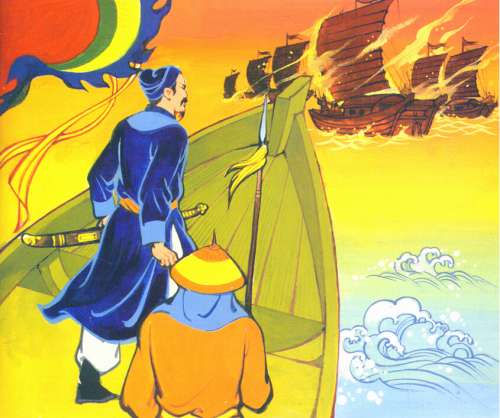
Đoạt sáo Chương Dương Độ
Đoạt sáo Chương Dương Độ
Cầm Hồ Hàm Tử Quan
Thái bình nghi nỗ lực
Vạn cổ thử giang san
(Trần Quang Khải)
Chương Dương cướp giáo giặc
Chương Dương cướp giáo giặc
Hàm Tử bắt quân thù
Thái bình nên gắng sức
Non nước ấy nghìn thu
(Trần Trọng Kim dịch)
oOo
In the history of Vietnam’s struggle for independence, the Lý dynasty (1010-1225) and the Trần dynasty (1225-1400) stood out as the two most glorious. During these four hundred years, the country produced far more heroes than at any other time, even though its land area was less than half of what it is now, with its southern border ending only at Nghệ An. Aggressors from the north, including the fearsome Mongols, had oftentimes been tempted by this beautiful land, yet every time they were crushed, with numerous generals, princes, and thousands of troops killed in fierce battles. Among the military geniuses and refined literati of these two dynasties were Lý Thường Kiệt and Trần Quang Khải. While Marshal Lý Thường Kiệt of the Lý dynasty achieved phenomenal military victories and penned the poem Nam Quốc Sơn Hà, known as the country’s first declaration of independence, General and Prime Minister Trần Quang Khải of the Trần dynasty accomplished similar astounding military victories and authored Đoạt Sáo Chương Dương Độ, a short celebratory poem of epic stature.
The Mongols, although more barbaric than other Asian groups at the time, were awesome warriors. Cruel and belligerent, they were crackerjack archers and cavalrymen with great mobility. They knew only one kind of order — the order of their leader. They would charge when so ordered even though they knew that the action would be fatal. Their ancestors were the Huns (Rợ Hồ or Hung Nô in Vietnamese). They were Buddhists, but they hardly understood the teachings of this noble religion (Phạm Văn Sơn 1960). That was the kind of enemies that our heroes of the Trần dynasty had to face.
Trần Quang Khải (1241-1294) was the third son of King Trần Thái Tông and a younger brother of King Trần Thánh Tông. Robust, handsome, and gifted in both literary and military arts, he played a major role in the campaigns against the Mongol invaders, in association with another stellar military strategist, General Trần Hưng Đạo. Of his many military triumphs, his watershed victory at Chương Dương Ferry in 1285 stood out, as it led to the liberation of the capital Thăng Long which had been occupied by Togan (Thoát Hoan) and his troops for a few months. In 1282 he became the country’s prime minister with great authority over national matters. In light of his tremendous service to the country, King Trần Thánh Tông bestowed on him the title of Prince Chiêu Minh (Chiêu Minh Vương) as a reward .
Toward the end of 1284, threatened with imminent capture by the Mongols, the capital Thăng Long had been abandoned. Yet, in the summer of 1285, King Trần Nhân Tông could return in triumph to his seat of power. At a royal banquet in Thăng Long celebrating this momentous victory, Prime Minister Trần Quang Khải recited a four-line poem that he composed in Chinese characters. Extolling glorious victories over ferocious enemies, providing sound advice for citizens during peace time, and praying for an eternal existence for the country, all in an elevated style, the historic poem was an epic in miniature.
We seized spears at chương dương ferry
We seized spears at Chương Dương Ferry [1]
We captured Huns at Hàm Tử Port [2]
In peace let us maintain our strength [3]
Forever shall live this nation
Trần Quang Khải
Đàm Trung Pháp translated into English and provided notes & references
NOTES
[1] Chương Dương Ferry is now in Thường Tín District, Hà Tây Province. It was here that Trần Quang Khải crushed Prince Togan (Thoát Hoan), a son of Kubilai (Hốt Tất Liệt), in 1285.
[2] The Huns (Rợ Hồ or Hung Nô) were a nomadic people, probably originating in northern central Asia, who invaded China in the third century B.C. and then spread westward to Asia and Europe. During the fourth century A.D., under their leader, Attila (A Đề Lạp), they overran much of the Roman Empire. Trần Quang Khải referred to the Mongols as descendants of the barbaric and destructive Huns. Hàm Tử Port is now in Văn Giang District, Hưng Yên Province. It was at this port that Trần Nhật Duật triumphed over Sogetu (Toa Đô), a Mongol general.
[3] The message of this verse is similar to the Latin adage Si vis pacem, para bellum meaning “If you wish for peace, prepare for war.” More than anyone else, Trần Quang Khải knew that a strong society would be less likely to be attacked by enemies. The Latin adage was by the fifth-century author Flavius Vegetius Renatus in his book De re militari or “Concerning military matters.”
REFERENCES
Huỳnh Sanh Thông (1979). The heritage of Vietnamese poetry. New Haven and London: Yale University Press.
Lê Hữu Mục (1960). Việt điện u linh tập (Lý Tế Xuyên, thế kỷ XIV). Saigon: Khai Trí.
Lê Ngô Cát & Đặng Huy Trứ (2009). Đại Nam quốc sử diễn ca. Saigon: Nhà Xuất Bản Văn Học.
Trần Trọng Kim (1971). Việt Nam sử lược (Quyển I). Saigon: Bộ Giáo Dục.
Nguồn: Dịch giả gửi
 Sáng Tạo